Google
Showing posts with label General Information. Show all posts

Tuesday, February 5, 2008

Thailand - Goverment, Politic

POLITIC


The politics of Thailand currently takes place in a framework of a constitutional monarchy, whereby the Prime Minister is the head of government and a hereditary monarch is head of state. Executive power is currently exercised by a military junta and its appointed Prime Minister and Cabinet. Legislative power is vested in a junta-appointed legislature. The Judiciary is independent of the executive and the legislature. Political activities are currently banned. Prior to the 2006 coup, the kingdom was a parliamentary democracy, with an elected bicameral legislature.


Thailand had been ruled by kings since the thirteenth century. In 1932, the country officially became a constitutional monarchy, though in practice, the government was dominated by the military and the elite bureaucracy. The country's current constitution was promulgated in 2006.


The King of Thailand has little direct power under the constitution but is a symbol of national identity and unity. King Bhumibol — who has been on the throne since 1946 — commands enormous popular respect and moral authority, which he has used on occasion to resolve political crises that have threatened national stability.


Currently, Thailand is run by a military Military junta calling itself the Council for National Security. On 19 September 2006, the CNS staged a coup d'etat that overthrew the elected government of Thaksin Shinawatra. Since that time, Thailand has been governed by a military junta headed by General Sonthi Boonyaratglin, who later appointed General Surayud Chulanont, who is a member of King's Privy Council, as Prime Minister. The coup and the governing junta were endorsed by King Bhumibol Adulyadej in a royal decree on the day following the coup

Thailand - National Symbols

NATIONAL SYMBOLS


national symbolsNational Flower: “Ratchaphruek“ (or golden shower)


Ratchaphruek is chosen as national flower because it is widely known to Thais, which it can be plant and seen anywhere throughout the country. It bears beautiful cluster-shaped flowers in summer. The color of flowers is shining yellow contrasting great importance similarly to the color of our national religion ‘Buddhism' and the color of Monday when His Majesty King of Thailand was born.


National Animal: “Chang Thai” (or Thai elephant)


national symbols2Thai elephant is selected as national animal because it has maintained close link with Thai history and custom, it has a long life, and it is closely related to the livelihood of Thai people as one of transportation means both in times of peace and battles. Especially, ‘white elephant' is deeply connected to King of Thailand, and white elephant was portrayed in the former national flag.

Thai tradition abounds with examples of the elephant playing an important role in the workings of the Kingdom. Most significant of all, perhaps, is the white elephant, prized because it is a rare animal judged fit only for royal duties.


According to ancient royal Thai traditions, a white elephant is a noble beast of special importance, exemplifying a king's honor and glory. Known in Thai as Chang Samkhan, a white elephant is a gift fit for a king and to acquire one during his reign, will bring about prosperity and happiness throughout the kingdom.


national symbols1National Architecture: “Sala Thai” (or Thai-style arbor)


Sala Thai reflects knowledge of Thai people. It retains beauty, which is different from architectures of other countries, and foreigners can acknowledge ‘Thai-ness' through Sala Thai.

Monday, February 4, 2008

Thai Social Structure

THAI SOCIAL STRUCTURE


In the Thai social system, the village is the unit. It was in former days, a self-contained one in its economy and needs. The people's habits and customs were based mainly o n agriculture and religion. Most villages had a Buddhist monastery and a shrine for a village deity. The monastery served their spiritual as well as the people's education. All arts, crafts and learning emanated from the monastery. From birth till death it centred round it. Its precincts were the meeting place for social g atherings on festive occasions. As to the village shrine it was used only occasionally in times of distress or on New Year's day when offerings were made. It had nothing to do with Buddhism.


No doubt Buddhism softened and tamed animism in many of its cults. The above is only a fundamental and comparative statement which a student has to bear in mind when dealing with mod ern cultural problems. The social system, habits and customs as seen in modern times are superficial modifications of the fundamentals and in a comparative degree only.


In some outlying districts where there are retarded developments of culture due to lack of intercommunication and new ideas, the people are still in their primitive state, quite in contrast to the progress in the capital, towns and cities.


In these progressive parts "old times are changed, old manners gone" and a new type of cultures fills its place. This is a sign of progress but it must come gratdually. Adapt the old to the new but not in a revolutionary way. The new cultures have also their dangers with problems to be solved, because people take too much interest in politics. To adopt new cultures wholly unsuited to the needs which are peculiar to, and characteristic of each particular place is a danger. Culture ought to be varied with characteristics of its own in each locality and area, harmonizing, however, with the whole-a unity in diversity.


Sunday, February 3, 2008

Thailand Geography - Economy, Geography, Climate, Natural Resources, Current Issue, Natural hazards

GEOGRAPHY

The kingdom of Thailand lies in the heart of Southeast Asia, making it a natural gateway to Indochina, Myanmar and Southern China. Its shape and geography divide into four natural regions : the mountains and forests of the North; the vast rice fields of the Central Plains; the semi-arid farm lands of the Northeast plateau; and the tropical islands and long coastline of the peninsula South.

The country comprises 76 provinces that are further divided into districts, sub-districts and villages. Bangkok is the capital city and centre of political, commercial, industrial and cultural activities. It is also the seat of Thailand's revered Royal Family, with His Majesty the King recognised as Head of State, Head of the Armed Forces, Upholder of the Buddhist religion and Upholder of all religions.

Thailand is a constitutional monarchy with His Majesty King Bhumibol Adulyadej, or King Rama IX, the ninth king of the Chakri Dynasty, the present king. The King has reigned for more than half a century, making him the longest reigning Thai monarch. Thailand embraces a rich diversity of cultures and traditions. With its proud history, tropical climate and renowned hospitality, the Kingdom is a never-ending source of fascination and pleasure for international visitors.

Location: Southeastern Asia, bordering the Andaman Sea and the Gulf of Thailand, southeast of Burma

Geographic coordinates: 15 00 N, 100 00 E,

Map references: Southeast Asia

Area:
total: 514,000 sq km
land: 511,770 sq km
water: 2,230 sq km

Area—comparative: slightly more than twice the size of Wyoming

Land boundaries:
total: 4,863 km
border countries: Burma 1,800 km, Cambodia 803 km, Laos 1,754 km, Malaysia 506 km

Coastline: 3,219 km

Maritime claims:
continental shelf: 200-m depth or to the depth of exploitation
exclusive economic zone: 200 nm
territorial sea: 12 nm

Climate: tropical; rainy, warm, cloudy southwest monsoon (mid-May to September); dry, cool northeast monsoon (November to mid-March); southern isthmus always hot and humid

Terrain: central plain; Khorat Plateau in the east; mountains elsewhere

Elevation extremes:
lowest point: Gulf of Thailand 0 m
highest point: Doi Inthanon 2,576 m

Natural resources: tin, rubber, natural gas, tungsten, tantalum, timber, lead, fish, gypsum, lignite, fluorite


Land use:
arable land: 34%
permanent crops: 6%
permxnent pastures: 2%
forests and woodland: 26%
other: 32% (1993 est.)

Irrigated land: 44,000 sq km (1993 est.)

Natural hazards: land subsidence in Bangkok area resulting from the depletion of the water table; droughts

Environment—current issues: air pollution from vehicle emissions; water pollution from organic and factory wastes; deforestation; soil erosion; wildlife populations threatened by illegal hunting

Environment—international agreements:

party to:
Climate Change, Endangered Species, Hazardous Wastes, Marine Life Conservation, Nuclear Test Ban, Ozone Layer Protection, Tropical Timber 83, Tropical Timber 94 signed, but not ratified: Biodiversity, Climate Change-Kyoto Protocol, Law of the Sea


Geography—note: controls only land route from Asia to Malaysia and Singapore


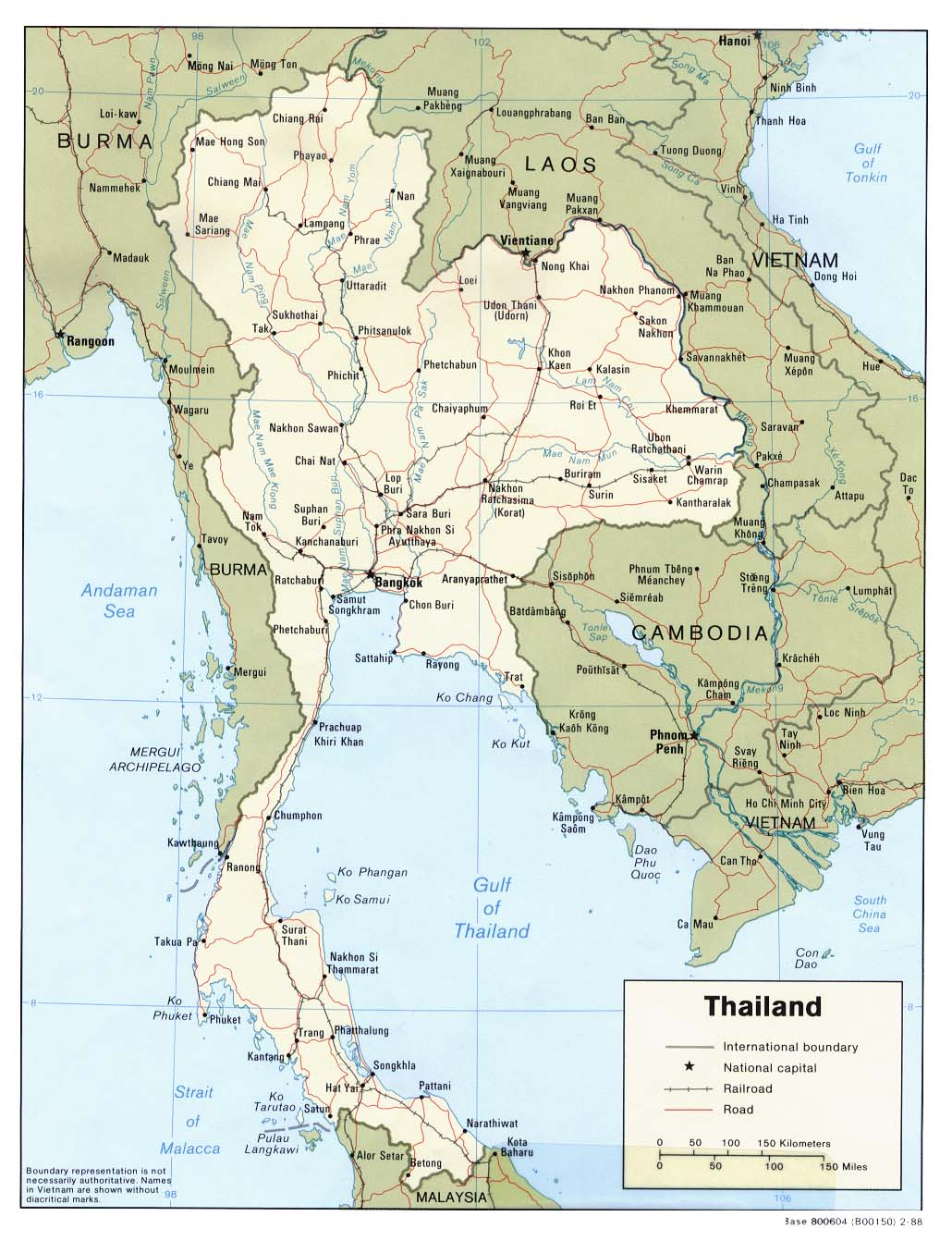
Thailand Map and Provinces

Click on the map to enlarge.


Thailand is divided into 75 provinces (จังหวัด, changwat) , which are gathered into 5 groups of provinces by location. There are also 2 special governed districts: the capital Bangkok (Krung Thep Maha Nakhon) and Pattaya, of which Bangkok is at provincial level and thus often counted as a 76th province.

Each province is divided into smaller districts. As of 2006 there are 877 districts (อำเภอ, amphoe) and the 50 districts of Bangkok (เขต, khet). Some parts of the provinces bordering Bangkok are also referred to as Greater Bangkok (ปริมณฑล, pari monthon). These provinces include Nonthaburi, Pathum Thani, Samut Prakan, Nakhon Pathom and Samut Sakhon. The name of each province's capital city (เมือง, mueang) is the same as that of the province: for example, the capital of Chiang Mai province (changwat Chiang Mai) is Mueang Chiang Mai or Chiang Mai. The 75 provinces are as follows:


Central
Ang Thong
Bangkok (Krung Thep Maha Nakhon), Special Governed District of
Chai Nat
Kanchanaburi
Lop Buri
Nakhon Nayok
Nakhon Pathom
Nonthaburi
Pathum Thani
Phetchaburi
Phra Nakhon Si Ayutthaya
Prachuap Khiri Khan
Ratchaburi
Samut Prakan
Samut Sakhon
Samut Songkhram
Saraburi
Sing Buri
Suphan Buri

East
Chachoengsao
Chanthaburi
Chonburi
Prachinburi
Rayong
Sa Kaeo
Trat

Phra That Chae Haeng, Nan Province
North
Chiang Mai
Chiang Rai
Kamphaeng Phet
Lampang
Lamphun
Mae Hong Son
Nakhon Sawan
Nan
Phayao
Phetchabun
Phichit
Phitsanulok
Phrae
Sukhothai
Tak
Uthai Thani
Uttaradiet

Phra That Phanom, Nakhon Phanom Province
Northeast
Amnat Charoen
Buri Ram
Chaiyaphum
Kalasin
Khon Kaen
Loei
Maha Sarakham
Mukdahan
Nakhon Phanom
Nakhon Ratchasima
Nong Bua Lamphu
Nong Khai
Roi Et
Sakon Nakhon
Si Sa Ket
Surin
Ubon Ratchathani
Udon Thani
Yasothon

Phra Boromathat Chedi or Phra That Nakhon, Nakhon Si Thammarat Province
South
Chumphon
Krabi
Nakhon Si Thammarat
Narathiwat
Pattani
Phang Nga
Phatthalung
Phuket
Ranong
Satun
Songkhla
Surat Thani
Trang
Yala


For more travel information of the provinces will discuss in specific topics.